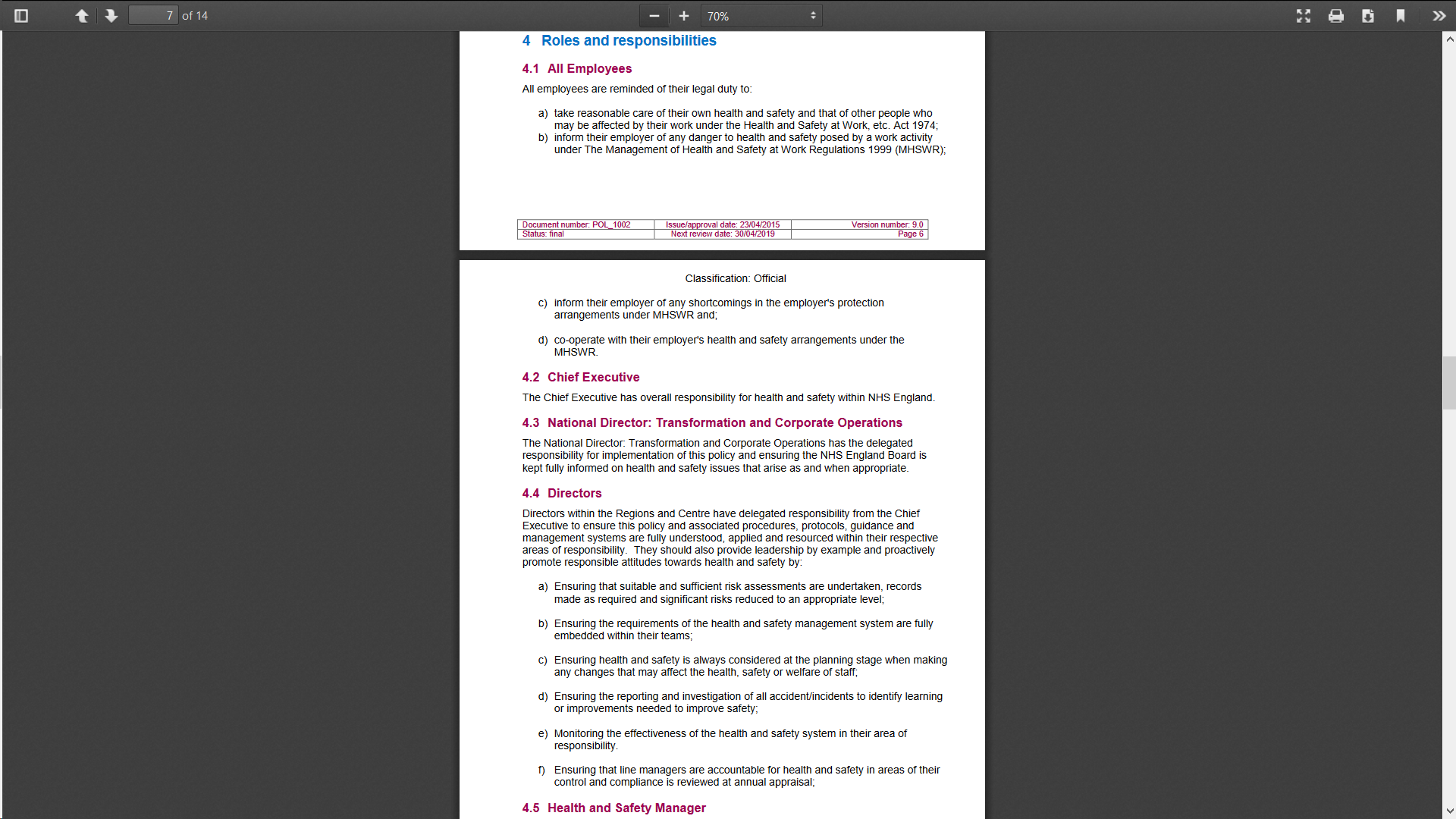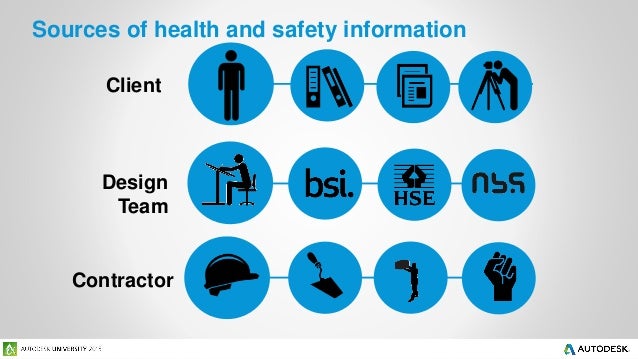
Sources of Health and Safety Information

https://image.slidesharecdn.com/cs11273bimforhealthandsafety-160120170158/95/bim-for-health-and-safety-its-a-nobrainer-73-638.jpg?cb=1453309437

When anybody, whether a health and safety professional, a manager, or an employee, is confronted with a health and safety problem, they will need to consult various items of published information to ascertain the scale of the problem and its possible remedies. The sources of this information may be inter to the organization and/or external to it.

Internal sources which should be available within the organization include:

  • Accident and ill-health record. absentee records.
  • Absentee records.
  • Inspection and audit reports.
  • OSH manuals and procedures.
  • Maintenance, risk assessment, and training records.

External sources, which are available outside the organization include:

  • Health and safety legislation.
  • International, European and National Standards.
  • Health and safety magazines and journals.
  • OSHA.
  • Worksafe, Western Australia.
  • Material Safety Data Sheets (MSDS)

For this blog, I’ll be focusing on 3 external sources of Health and Safety and will be evaluating them. These include HSE, OSHA, and CCOHS.
1.
http://www.hse.gov.uk/

Health and Safety Executive

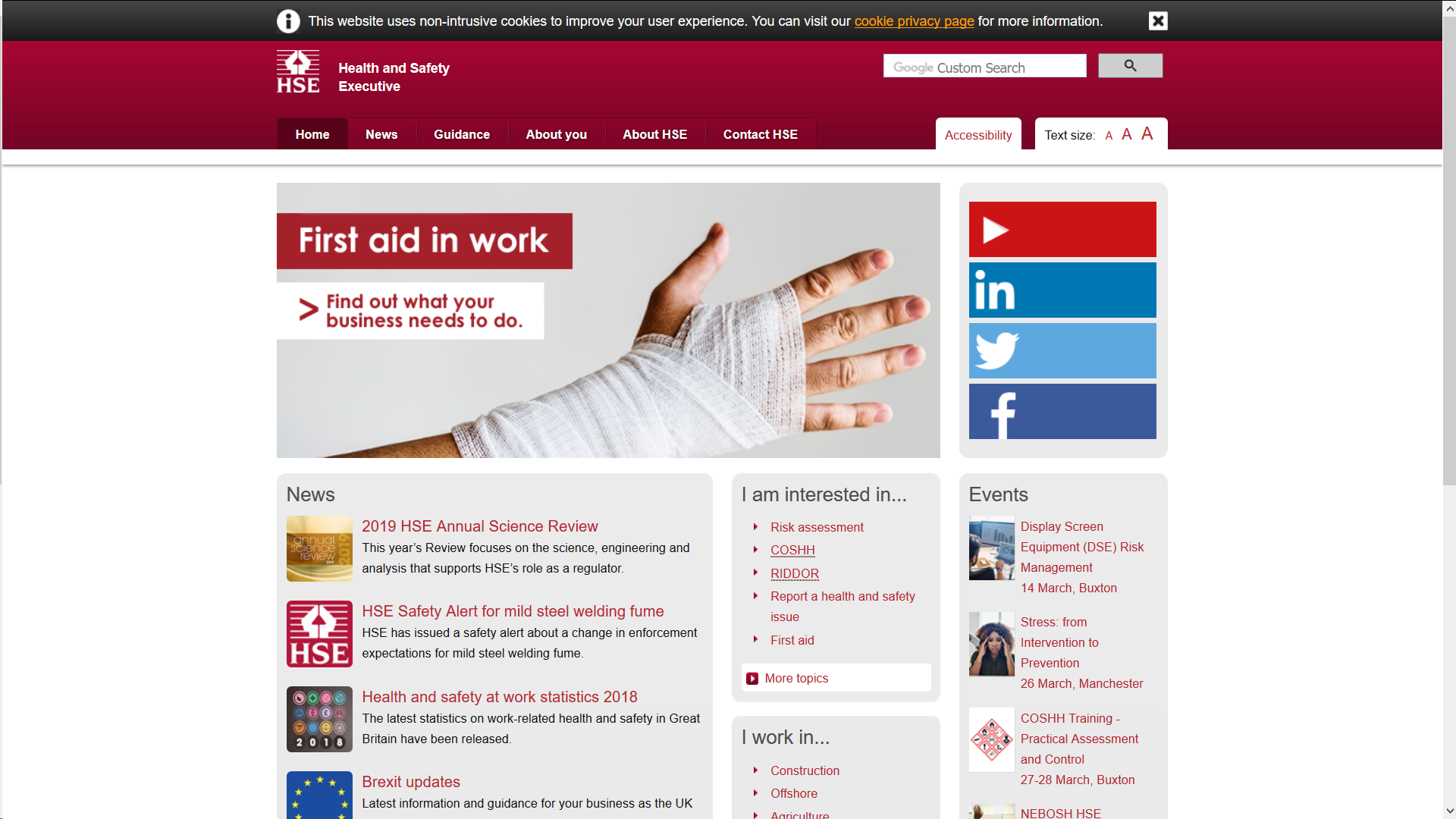
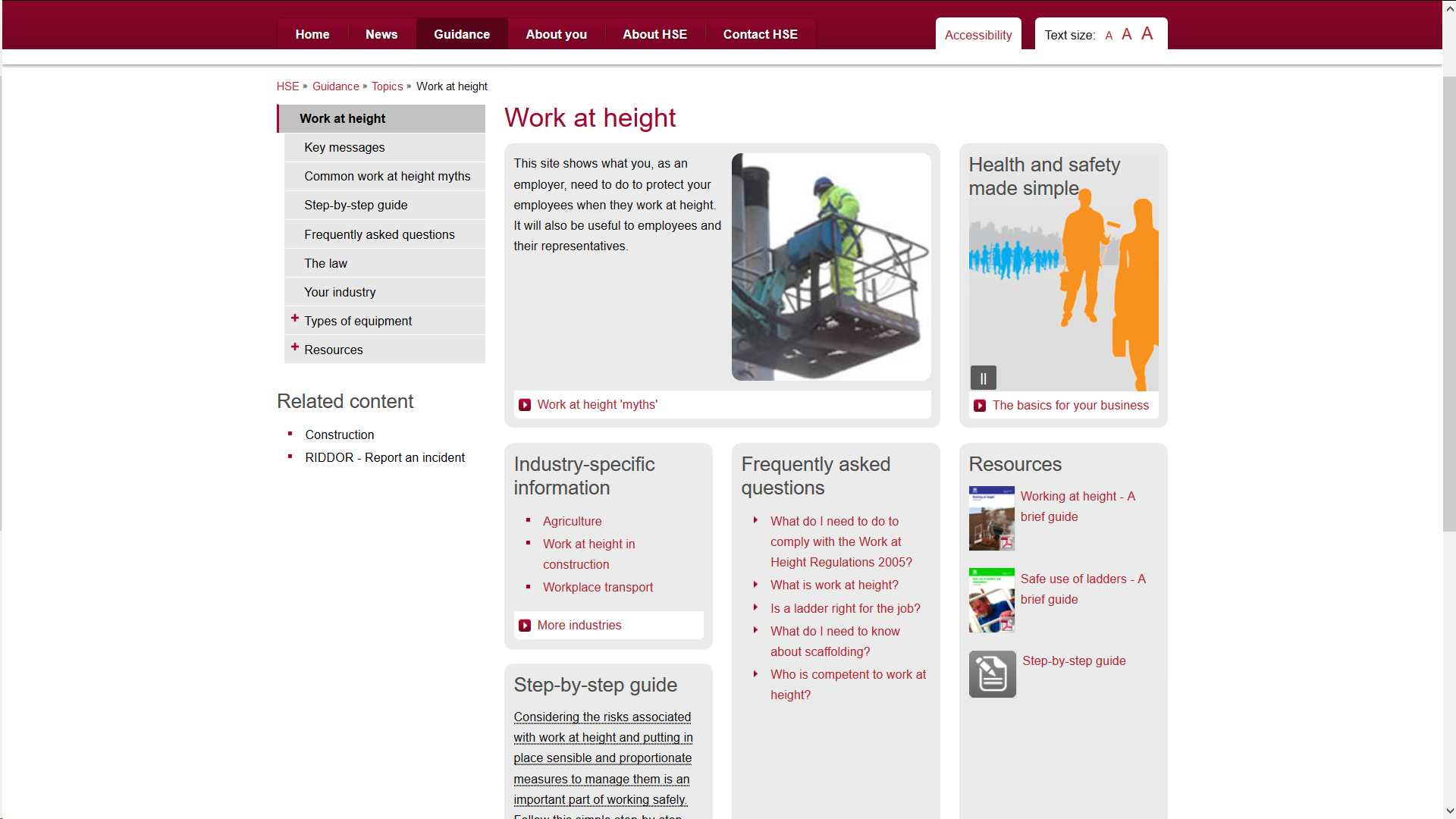
The Health and Safety Executive is a UK government agency responsible for the encouragement, regulation and enforcement workplace health, safety, and welfare. The website has a great layout and is well organized. It covers several topics regarding Health and Safety and the information is quite easy to navigate as well. As seen in the picture above, there are 6 tabs that direct you to the appropriate content. Each tab contains relevant information as well as FAQ, industry specific information, laws, and step by step guide regarding the chosen topic. It also includes news, events, and several recommendations.

Here is an example:
Work at height

2.
https://www.osha.gov/

OSHA

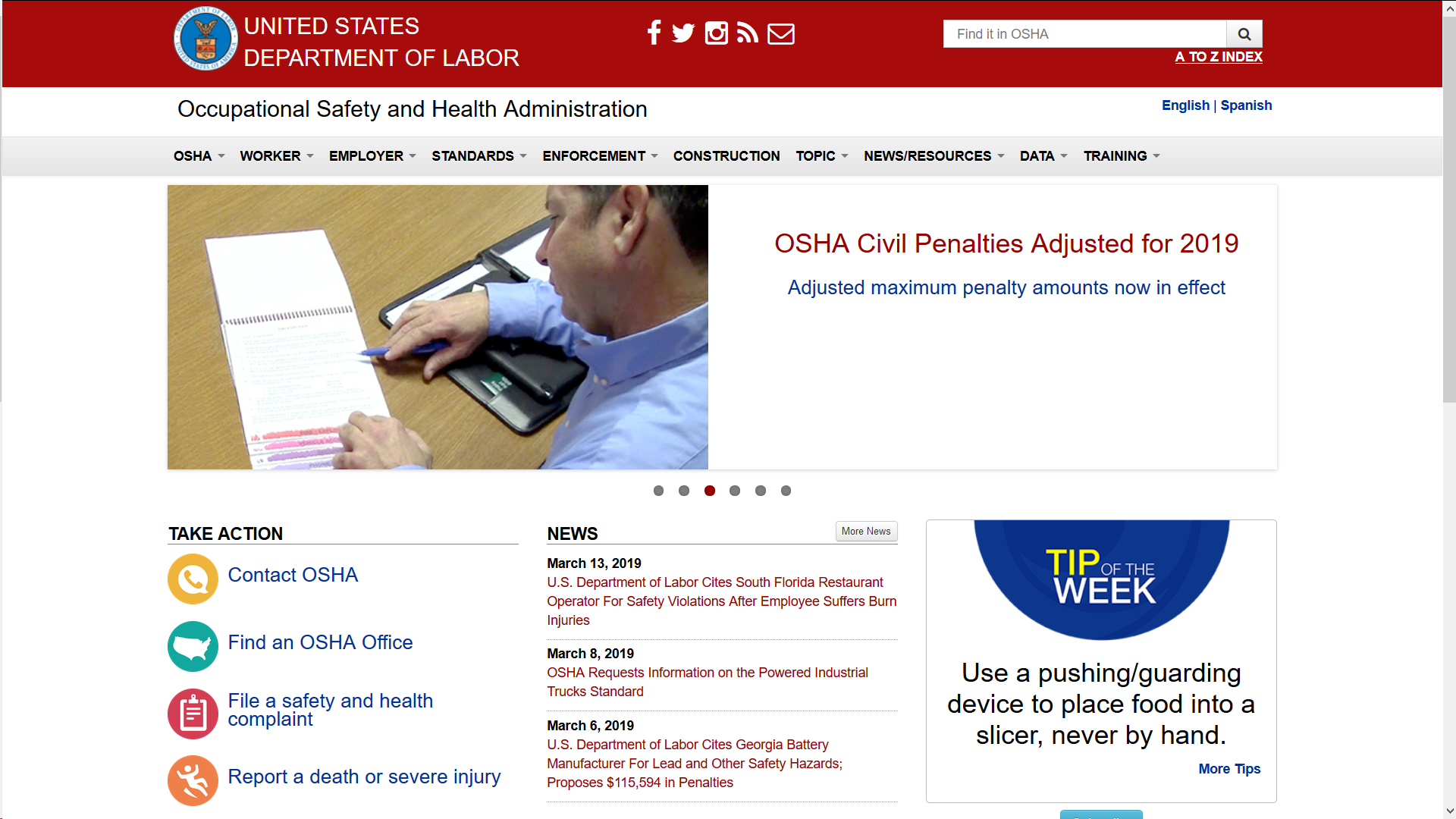
OSHA is part of the United States Department of Labor. The administrator for OSHA is the Assistant Secretary of Labor for Occupational Safety and Health. OSHA’s administrator answers to the Secretary of Labor, who is a member of the cabinet of the President of the United States.

As seen from the picture above, it is quite easy to navigate and includes information regarding the workers, employers, standards and so forth. There is information on statistics, training, as well as news regarding Health and Safety. What I found quite interesting was a page on construction industry which covered topics such as confined spaces. The web page provides details such as standards, register notices, and case studies on those specific topics.

Below is an example:
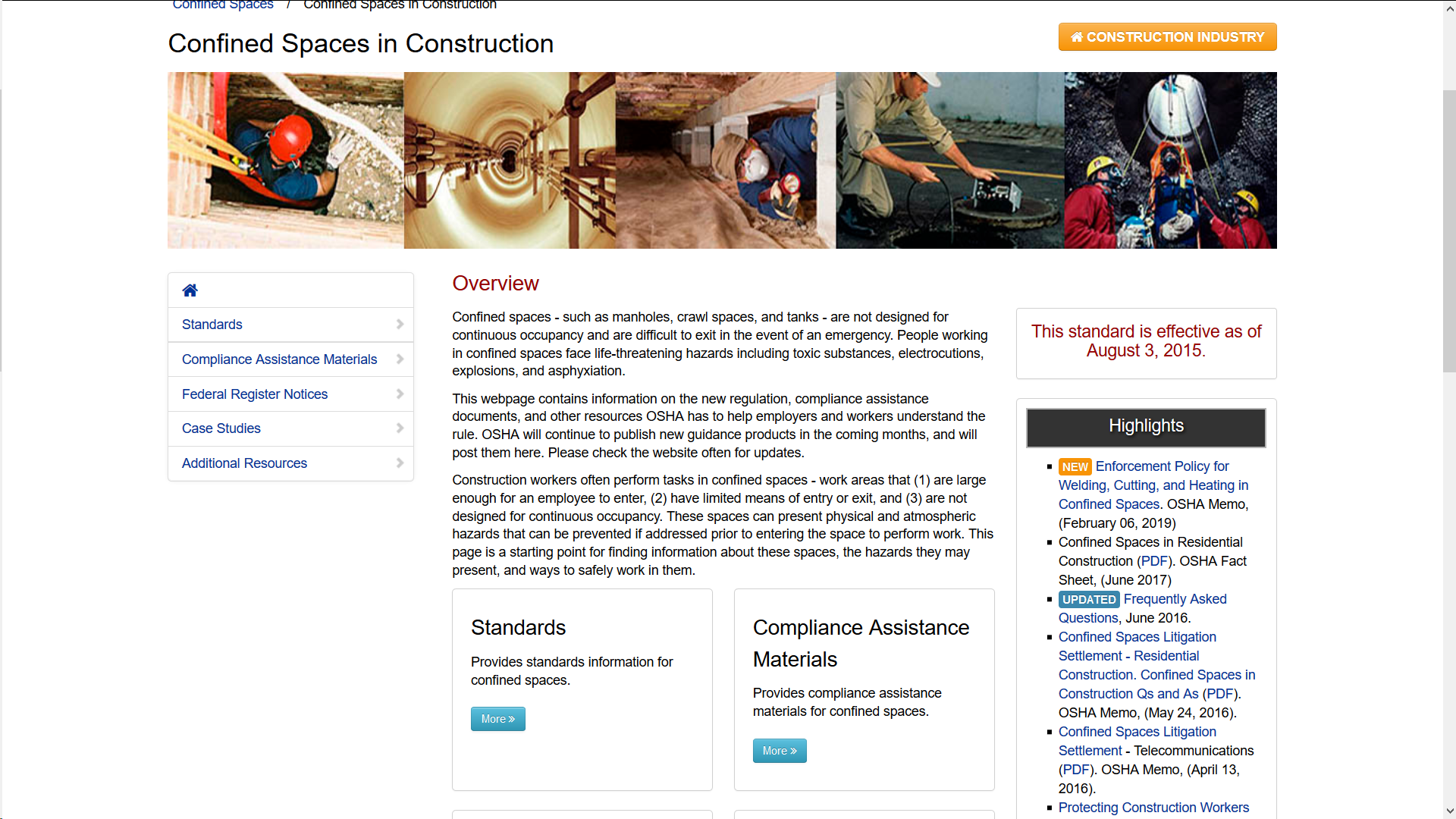
Construction Industry/ Confined Space

3. https://www.ccohs.ca/

CCOHS

CCOHS is Canada’s national resource for the advancement of workplace health and safety.
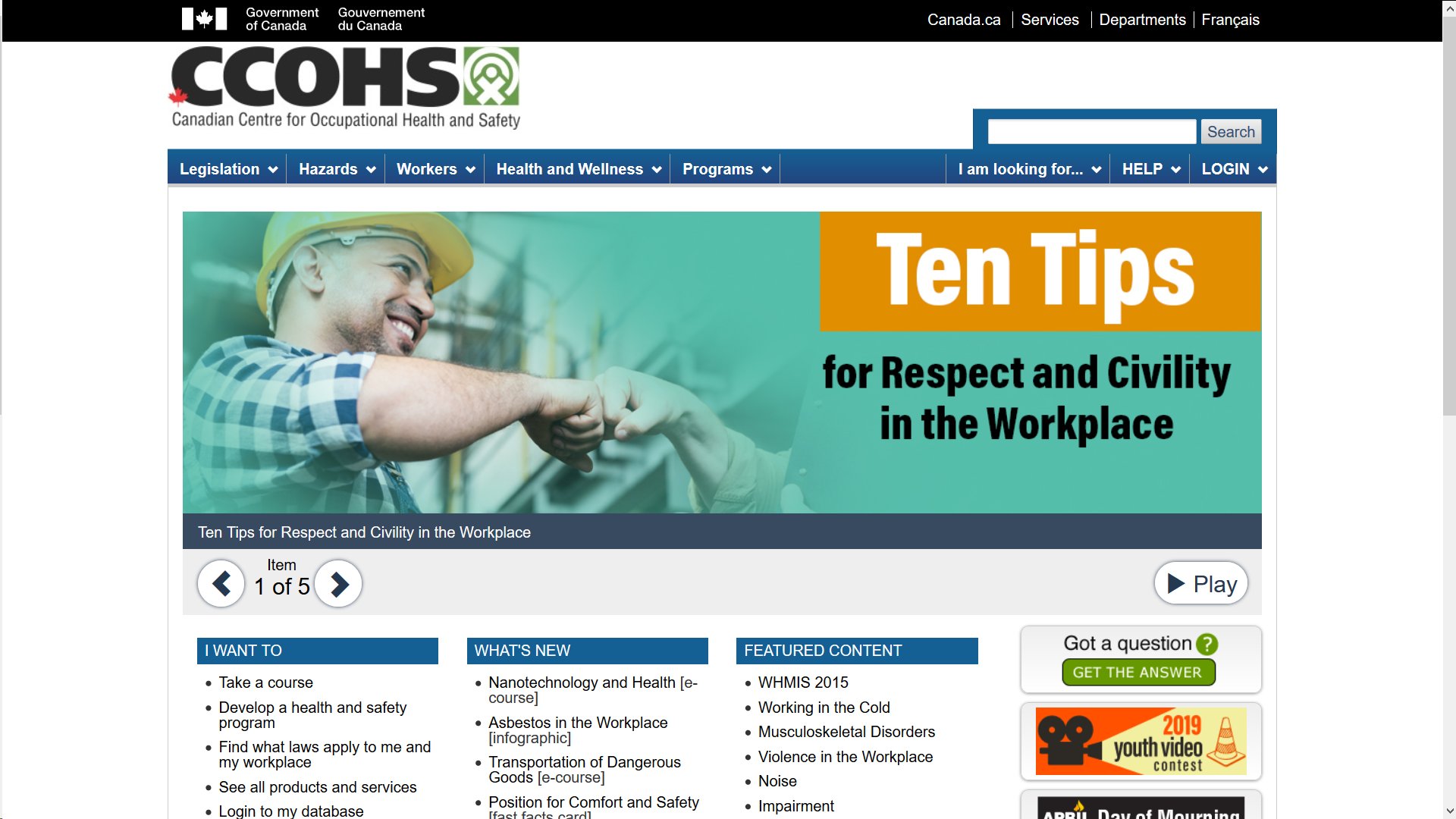
CCOHS was established in 1978 by the Canadian Centre for Occupational Health and Safety Act, which was passed by unanimous vote in the Canadian Parliament. CCOHS promotes the total well-being – physical, psychosocial and mental health – of working Canadians by providing information, training, education, management systems and solutions that support health, safety and wellness programs. A federal department corporation, CCOHS is governed by a tripartite Council – representing government, employers and labour – to ensure a balanced, approach to workplace health and safety issues. We offer a range of workplace health and safety services to help your organization raise awareness, assess risks, implement prevention programs, and improve health, safety and well-being.

The website has a good layout and navigating it is easy as well. It covers information regarding legislation, hazards, workers, health and wellness, and programs. The hazards tab covers information from ergonomic, chemical, physical, psychological, and workplace hazards. The same sort of layout is applied to rest of the tabs. What I found intriguing was the abundance of information in the Health and Wellness tab. I believe that it is crucial to mention information such as these, since it sheds light upon the effect it has on the workers.

Below is an example:

Health and Wellness

In conclusion, I found these external sources of Health and Safety Information quite beneficial. It broadened my knowledge on aspects of Health and Safety as well gave me an insight on how I can use this information to my benefit. As a future HSE practitioner, I would be able to implement relevant information from these sources and work effectively. All 3 sources of external information were quite easy to navigate and I did not find anything that I disliked about them.

Joint Health and Safety Committee

Image result for health and safety committee image

Before I delve into details about the significance of a Joint Health and Safety Committee in developing a positive health and safety culture, let us start of by defining what culture is.

A culture, by definition, is the ideas, customs, traditions, and general social behavior of a specific group of individuals.

Image result for culture
“A nation’s culture resides in the hearts and in the soul of its people”

Now that we have a brief understanding about what culture is, let us get into details about a health and safety culture of an organization.

According to HSG56, the safety culture of an organization is the product of individual and group values, attitudes, perceptions, competencies, and patterns of behavior that determine the commitment to, and the style and proficiency off , an organization’s health and safety management.

Image result for health and safety culture

There are certain elements that make a positive health and safety culture and these include:

Related image

If an organization adheres to these elements, then a basis for a good performance in health and safety will have been established. However, to achieve this levels of performance, sufficient financial and human resources should be made available for the health and safety function at all levels of the organization.

There are several factors that can compromise health and safety culture at work. These include human factors such as the organization, the job, and individual factors. All 3 factors tend to influence the behavior at work. I’ll provide a brief summary of these factors shortly, since it is important to highlight these in order to overcome the challenges.

Image result for human factors which affect work

Besides the human human factors, there are also errors and violations that could affect the health and safety at work. Errors are unintentional deviation from an accepted standard, whereas violations are deliberate deviation from the standard.

Image result for human errors and violations
Image result for health and safety committee

Now that I’ve covered all the necessary information, let’s get into detail on how a joint health and safety committee can help improve health and safety culture at work. Below is an outline on how the committee can improve OHS standards:

  1. Demonstrating management commitment.
  2. Promoting OHS standards.
  3. Developing competence.
  4. Keeping up to date with OHS laws.
  5. Communicating effectively.
  6. Consulting with the workforce.
  7. Training in health and safety.

The committee demonstrates management commitment through active involvement of employees in health and safety. Continual improvement of health and safety standards. Reduction in accident rates. Review status of health and safety. Ensure appropriate health and safety actions are taken.

It promotes OHS standards by controlling work activities, competence, maintenance, and supervision. Involves the managers and implements the use of PPE as well as comprehensive accident reporting.

It develops competence by implementing competence training programs. Provide training to all participants at no cost and appointing health and safety advisors.

The committee keeps up-to-date by regularly checking OHS organization, as well as international sources of information. It also checks OHS wold websites and health and safety periodicals.

The committee uses 3 basic methods to communicate effectively with the workforce. These include verbal, written, and graphic. Verbal is the most common method of communication. Written includes memos and emails written in a straightforward manner and a clear language. Finally, graphic method includes the use of drawings, photos, or videos.

The committee represents the whole organization and includes members form both workforce and management. It also dictates two chair positions, one representing the workforce, while the other represents the managers.

The joint health and safety committee can improve health and safety through range of trainings such as : induction, job specific, supervisory and management, and lastly specialist training.

In summary, a joint health and safety committee can improve the health and safety culture through specific duties. It looks at the negative points of the organization and makes changes in order to improve the OHS standards.
Reflecting back on the meeting, we somewhat followed the same procedure that a professional committee does. We discussed several topics which included accidents in the workplace, statistics, and proper management. We all voiced our opinions and made recommendations about improving OHS standards.

Image result for joint health and safety committee

Reviewing a Health and Safety Policy

https://www.england.nhs.uk/wp-content/uploads/2017/04/pol-1002-health-safety-policy.pdf

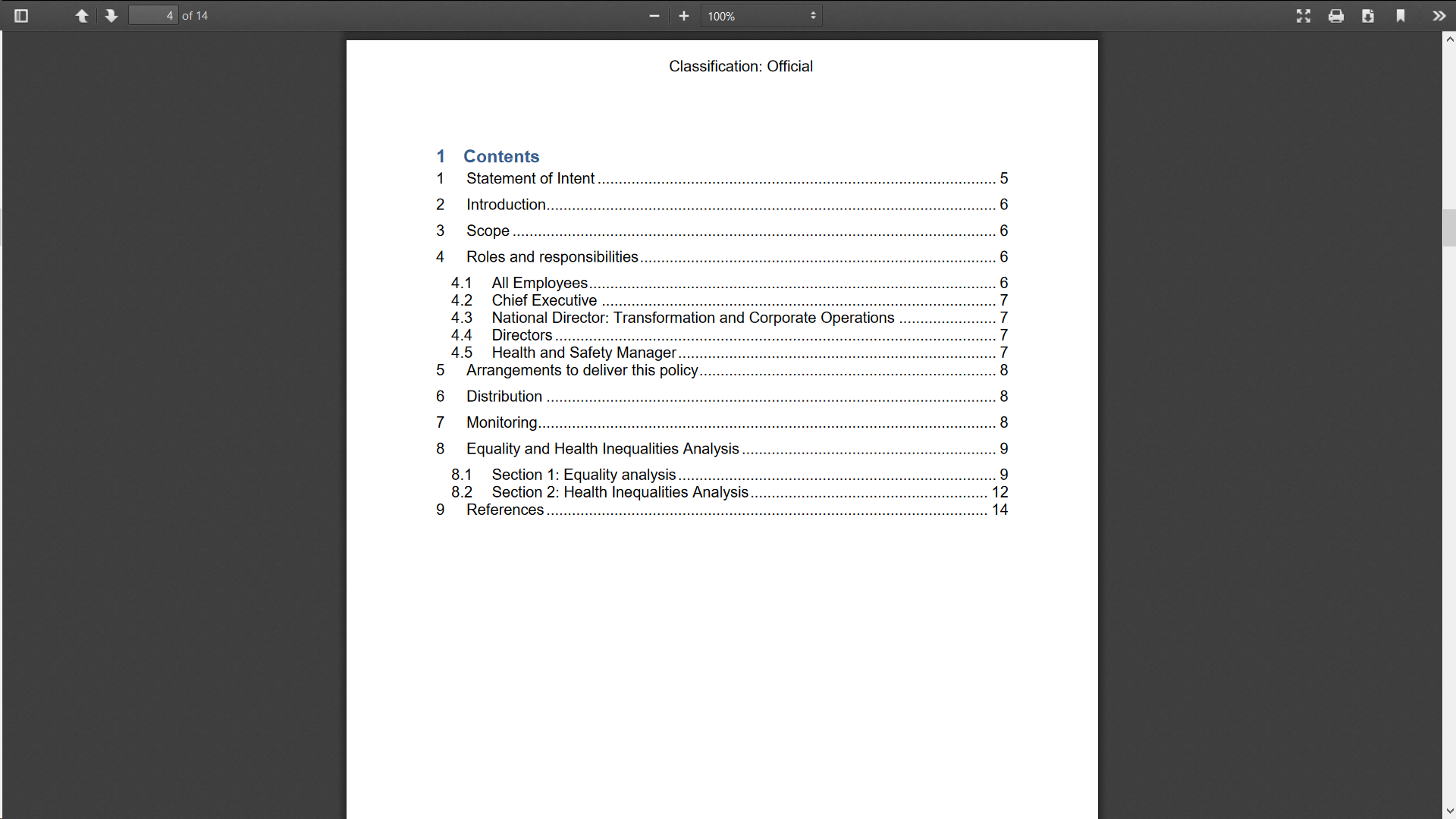
This policy covers all the 5 elements, which include statement of intent, objectives, organization, arrangements, and information on review. However, there are some details and key points that are not covered in this policy.

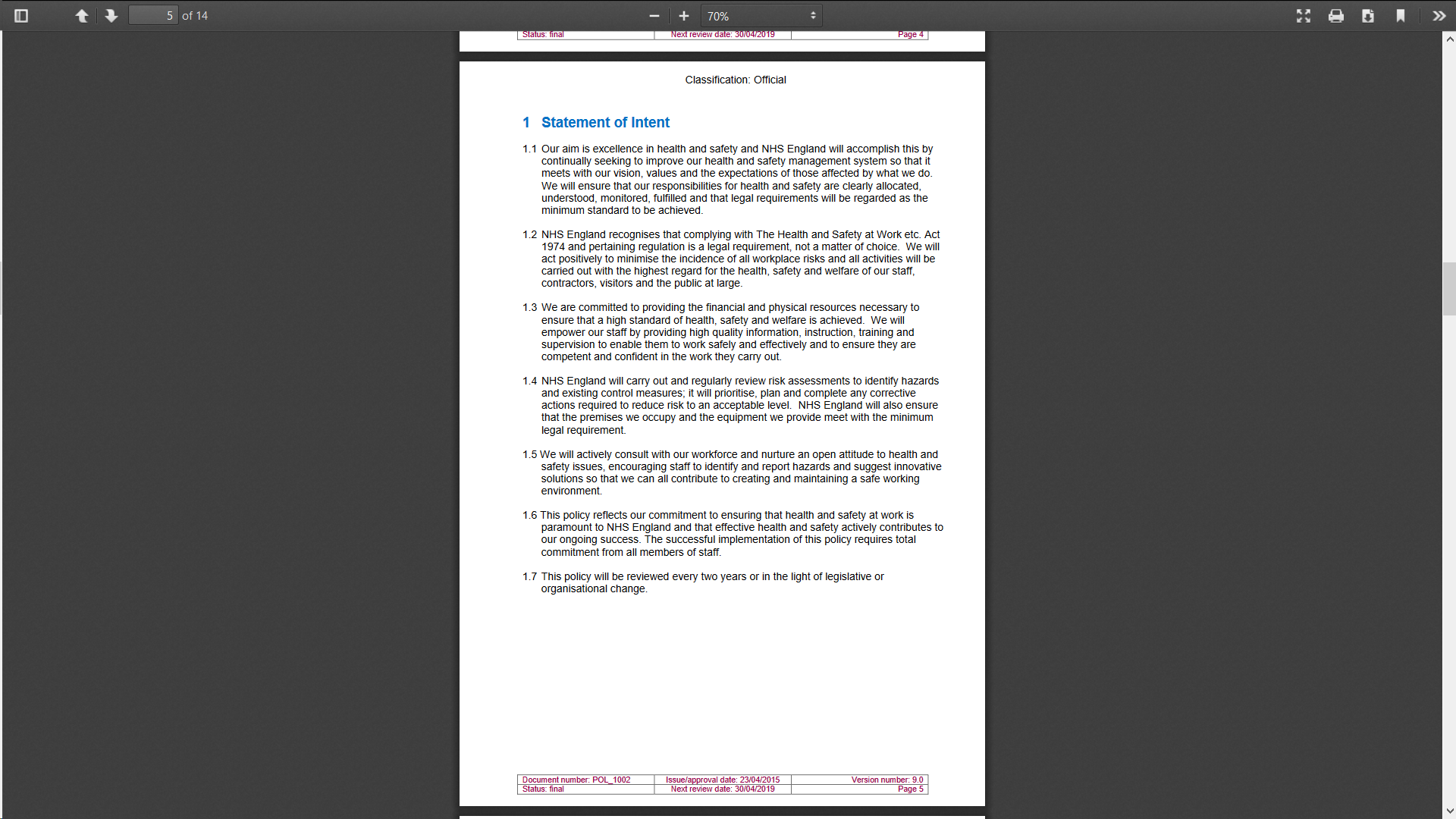
The statement of intent is written in simple and clear language. It contains the aims and the objectives of the organization. It also includes performance targets. However, it is not dated and signed by the senior member of the organization. As seen below:

The objectives are clear. However, I believe that they could have been stated better by following the SMART protocol. There are no indication of KPI’s (key performance indicators.)

As for the organization, everyone seems to have a role to play and have their own set of responsibilities. It seems pretty clear as to what each person is responsible for.

There are arrangements for emergency protocols, training procedures, risk assessments, and so forth.

The only information regarding review is mentioned in the statement of intent. It states that the policy will be reviewed every two years or in the light of legislative or organizational change.


About myself

I am Abdulla Ansari, a first year OHS student at the College of North Atlantic Qatar. My current goals include graduating the OHS program with Honors and achieving all the remaining NEBOSH certificates. My hobbies include reading, mostly fiction, since it allows me to connect to the characters in the books and understand things from their perspective.